Remember the first time you fell in love? You had been waiting for weeks for the moment when suddenly the doorbell rings. You rush to the door and see a tall, handsome man. He smiles and says “special delivery”. The moment you had been waiting for was finally here; your new Dubé juggling clubs had arrived.
We recently asked our Facebook followers about their first Dubé experience. We received a flurry of responses, here are some of our favorites:
MJ:I got a set of 5 stage balls and a set of European juggling clubs in the early 90s, when I was in high school.
RP: Euro clubs in the mid-eighties. Ah, fond memories of the early days…
CAR: Hideous 8-panel neon squosh balls…that I thought were SO COOL in 2000.
DG: The american style clubs,white with silver very early 80’s. They lasted hundreds, hundreds of shows. a dozen moves and finally got a crack after 100 sidewalk drops in 2008.
JW:One order: 9 classic American clubs, devil stick, 9 ABS rings, and some other stuff (torches?). The year was 1980, 8th grade. I ran to the mailbox every day for 12 weeks before those beauties showed up!
RC: All the folks I juggled with had their props for years… many of them would have had them from the late 70s — that is mostly why I went with Dubé over all the other options, yours had the best feel overall, and they hold up to use for years to come!
JDM: I got some Dube clubs in the late 70’s. I still have ’em although they have been gathering dust for a long time. Wait, I think my ex wife got them in the settlement.
Thought scarf juggling was just for kids? Think again. As the following videos demonstrate, scarves are quickly becoming the most extreme juggling prop out there!
Marvel at the technical expertise of master scarf juggler Bret Wengeler! My Sharona!
Is there anything more extreme than several dozen 4th graders simultaneously juggling scarves to Taio Cruz’s Dynamite? We think not!
Finally, Juggling mistress Divertida Devotchka of the Vixens of Vaudeville shows us that scarf juggling can be mysterious and erotic…
As jugglers, most of us lack the marketable skills necessary to stay competitive in today’s job market. Luckily, Dubé Juggling Blog is back with another helpful and informative guide.
Photo by Dan Harrelson via Flickr
-Flair bartending is a great way to earn extra tips and waste tons of alcohol.
-Panhandling is the second oldest profession on earth. You could always give that a try.
-Expert whip cracker and rope spinner? Have you considered an exciting career as a dominatrix?
-Teaching juggling to children is a great way to make sure that the next generation makes the same horrible decisions that you made.
-Professional athletes get paid pretty well. Maybe you could give that a try? Couldn’t hurt.
-Who needs a job? Just get a fire staff and set of poi and spend your days hopping from festival to festival.
-If you join the military, refrain from juggling live grenades.
-FOR THE LOVE OF GOD, DO NOT MENTION THE WORD “JUGGLER” ANYWHERE ON YOUR RESUMÉ.
-If push comes to shove, you can always resort to this:
While Dubé Juggling and company are spending the summer trying to innovate props some of you have the summer off. Lots of time to sleep late, and pick up a skill or two. Here’s our summer to do video list to keep boredom away for FREE with no special equipment.
Airlines get away with murder by charging for baggage. Why not leave everything behind by working with whats on hand.
Stuck at home with nothing to do and nowhere to go? Turn your basement into the ultimate ping pong bouncing playground. Not a bad skill to take on to college either.
The ultimate fidgety time killer. Just try not to wear a white shirt while learning.
Managing the responsibilities of parenting can be tough. As jugglers, we’re up to the task. Follow these parenting tips to juggle your way to happier, healthier kids.
-Try to have triplets. It’s easier to juggle the children when they’re all the same size and weight.
-It can be difficult to get your kids to eat healthy. Teach them the eat-the-apple trick to make sure they get fiber and vitamins.
-Diabolo is a great babysitter. Not only will this challenging skill toy keep your child occupied for hours on end, you can also use the string to tie them up when they misbehave.
-If your child asks you to buy them a Fushigi ball, explain to them that the Fushigi is actually just a contact juggling ball and that contact juggling was pioneered by Michael Moschen and popularized by the movie The Labyrinth with David Bowie. Then, scare the living daylights out of your children by actually showing them this movie. After this, they should no longer be interested in the Fushigi ball.
-When teaching your children fire juggling, be sure to coat them with a non-toxic flame retardant spray. Flame retardant sprays now come in an array of kid-friendly flavors, such as watermelon, bubblegum and cool ranch.
-Make sure your children don’t get involved in drugs by keeping them away from poi spinning.
-If your child cannot juggle three balls by the time they are 10 years old, it’s ok to completely disown them.
-Disciplining your kids can be tough. Any time they act up, threaten them by showing them this video:
Congratulations! You’ve gotten a date. The dating scene can be rough for today’s juggler, but have no fear. Dubé Juggling Blog is here with romantic dos and don’ts for the dashing juggler on the go:
Via Flickr from Rem-Zel
-Explaining siteswaps is a great icebreaker.
-Juggling helps you relax in high-pressure situations. Make sure to get a good run of five-ball cascade in before attempting a kiss goodnight.
-Impress your date with stories about how many romantic partners you’ve juggled in the past.
-Spontaneity is an attractive feature. Surprise your date by standing on the dinner table and juggling breadsticks while singing the theme to The Bodyguard.
-Anytime anything happens, find some way to relate it to juggling.
-Reassure your date that, despite the fact you ride a unicycle, all of your downstairs parts are in working order.
-Most people are more comfortable in the company of friends. Take your date to the local renaissance festival or freak show so they can see you in your element.
-Methodically listing every festival you’ve ever been to is great way to kill an hour between dinner and a movie.
-Be sure to wear juggling-related t-shirts, so your date knows you’re for real and not just faking it.
-Always balance a barstool on your chin as soon as you walk into any bar.
-Don’t mention that you’re a juggler until the 6th or 7th date.
Summer is around the corner, and that means peak season for juggling. Worried about looking like a geek in front of all of the cool jugglers? Don’t sweat; the Dubé Juggling Blog has your back.
Latest in Juggler Fashion
-Rainbow suspenders are a snazzy way to keep your pants up. Scrolling LED belt buckles are another option. Diabolo string should only be used as a last resort.
-When people hire a juggler, they expect a certain level of cleanliness. Make sure to live up to their expectations by not showering and sleeping in your performance clothes the night before.
-Shoes say a lot about a person. If you wear clown shoes, it says “I’m a clown”. If you go barefoot, it says “I’m a dirty hippie”.
-Hats are not only an awesome way to liven up your on-stage persona, they’re also an effective method of covering up that unsightly juggling knife-related head wound.
-Wearing juggling festival t-shirts every day is a fun, casual way to remind everyone that you go to a lot of juggling festivals.
-Chest hair is the new black. This means it’s safe to break out your sequenced v-neck spandex leotards.
-If performing at a renaissance festival, make sure all of your attire and accessories are period-appropriate. Zippers weren’t invented until 1851, velcro wasn’t invented until 1948, and your bluetooth headset wasn’t invented until 1994.
-Amusing facial hair is a great way to distract the audience from a crappy juggling routine.
-Change your hairstyle depending on the event and location. When juggling in New Jersey, fauxhawks are appropriate. When poi spinning at Burning Man, make sure to weave a bunch of yarn, rooster feathers and other crazy crap into your dreadlocks.
-If you get a high-scale gig but can’t afford a tuxedo, it is acceptable to wear a t-shirt with a picture of a tuxedo.
-A unicycle isn’t just a one-wheeled bicycle with no handlebars, it’s also a fashion accessory. Make sure to “trick out” your wheel by adding chrome spinning rims, a leopard skin print saddle, and a solid gold air cap.
-It’s considered tacky to juggle white props after Labor Day.
The French have given us many things: the Statue of Liberty, the bikini and of course, the word “juggler”. As Merriam Webster’s dictionary explains, the word “juggler” evolved from the Middle English world jogelour (a minstrel or magician), which came from the Anglo-French term jugleur. This word evolved from the Latin term joculator, a derivative of joculari, which means to joke or to jest. This word, in turn, was derived from the Latin noun iocus, which means “joke”.
The evolution of this word leads us to an interesting conclusion: the first “jugglers” were not jugglers at all. Rather, they were roving performers who made a living telling jokes, singing songs and performing various stunts (which may or may not have included juggling). They were more closely related to troubadours, jesters or minstrels and were not “jugglers” in the modern sense of the word.
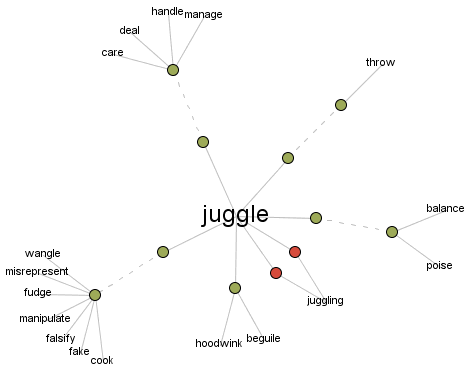
Often, these traveling performers were not highly regarded socially, and were known for trickery. It is for this reason that “juggle” has a number of negative connotations. Dictionary.com lists “to alter or manipulate in order to deceive” and “to use artifice or trickery” as alternative definitions.
As this blog has pointed out, the word “juggling” has taken on new connotations in recent years. A quick Google News search for “juggling” will find more articles about President Obama juggling priorities in the Middle East than it will about Anthony Gatto or the International Jugglers Association. In common usage, juggling most often refers to the act of multitasking: juggling family and a career, juggling multiple lovers etc.
Even among those who use “juggle” to refer to object manipulation, there isn’t any consensus as to what the word actually means. Some use the term to refer to “toss juggling”; keeping more objects in the air than number of hands used. Others insist that contact juggling, which often envolves only one object, should be considered “juggling” as well. Still more think that cigar box, devil stick and diabolo should be categorized as juggling.
According to Merriam Website, the word “juggle” first appeared in the English language in the 15th century. If the term seems a little vague to you today, just remember that it’s been that way for nearly 600 years.
The following is an explanation of Shannon’s Juggling Theorem, developed by legendary mathematical, engineer and juggler Claude Shannon. This posting is based on articles written by mathematicians Ron Graham and Joe Buhler.
In mathematical terms, a juggler juggles five variables. He is free to vary the number of balls (b) he is juggling, the number of hands (h) he juggles with, the flight time (f) of each ball between his hands, the length of time a hand is empty (e) between catches, and the length of time a ball dwells (d) in a hand between throws. We assume that for a given pattern that all the above variables are constant and that no two balls are ever in the same hand at the same time and that the pattern is periodic (each configuration
of balls occurs at fixed intervals). These assumptions imply that the pattern has a certain symmetry and stable rhythm. This is true for the cascade but not for the shower which requires more complex mathematical descriptions. Consider two time lines, each representing one period (p1 or p2), one from the ball’s perspective and one from the hand’s perspective:
From the ball’s perspective, the length of one period is equal to the
number of hands times the combined time that a ball dwells in one hand
and is in flight, for each hand it meets:
a) p1 = h(d+f)
From the hand’s perspective, the length of one period is equal to the
number of balls times the combined time that the ball dwells in a hand
and that the hand is empty, for each ball it meets:
b) p2 = b(d+e)
Since the two periods are equal (p1=p2) (just considered from two different perspectives) we have:
c) b(d+e)=h(d+f) or:
d) b/h=(d+f)/(d+e)
We call this Shannon’s Juggling Theorem.
We can see from this theorem that each variable in juggling is related to and affected by changes in the others. Many relationships can be explored with this theorem. For example, what are the limits of the juggler’s freedom to vary the speed of a juggling pattern? We can fix the number of balls, hands, and the throw height (and, therefore, the flight time). The juggler can slow the pattern down by holding the ball longer or can speed it up by releasing each ball faster. The limit in the first case where the ball is held as long as possible is: empty time=0. Using equation c) above and setting e=0, we get:
e) bd=h(d+f).
The limit in the second case where the ball is held as short as possible is:
dwell time=0. Setting d=0 we get:
f) be=hf.
The ratio of these two extremes (between fastest and slowest) is bd/be=d/e
Solving equation e) for d yields d=(hf)/(b-h).
Solving equation f) for e yields e=(hf)/b.
So the ratio of fastest to slowest speeds (or period lengths) is
d/e=[(hf)/(b-h)]/[(hf)/b] or:
g) b/(b-h)
According to this ratio, b/(b-h), the range of possible juggling speeds decreases with the number of balls (and increases with the number of hands). So for a juggler using two hands and three balls, the ratio between the fastest and slowest speeds is 3/(3-2) or three to one. For a jugglerusing two hands and SEVEN balls, the ratio is 7/(7-2) or only 1.4 to one. Thus, one can see how the addition of more balls dramatically constrains the juggler. Of course, the extremes of fast and slow juggling are only possible in theory since a juggler can’t make the dwell time or empty time actually equal to zero. Therefore, the ratio of achievable speeds is even smaller.
We would like to thank Ron Graham and Joe Buhler for use of their work…
and of course a special thanks to Claude Shannon.
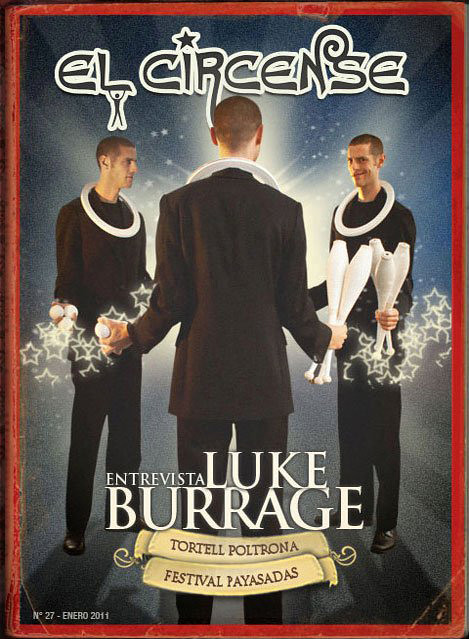
As part of our partnership with El Circense, the Spanish language digital magazine, we will be republishing some of their original content, in English. This week, we present an in-depth interview with juggler Luke Burrage from January 2010.
By Marco Paoletti
Who is Luke Burrage?
I’m Luke Burrage, and I’m a juggler. I first learned to juggle back in 1991, got more serious about it around 1997, and turned professional in 2003.
What is your speciality?
Over the years I’ve specialized in many different areas. Once I was best known for numbers juggling, equaling the world record with a 12 ball flash, and setting passing records with Ben Beever at 18 then 19 balls. I also did a lot of research into juggling notation, developing a system called Beatmap, which isn’t that widespread, but I find useful on an almost daily basis.
I’ve also been well known for releasing juggling videos online. Back in 2001 and 2002, long before YouTube made sharing videos effortless. I was getting 300-400 video downloads per day from my website. That’s probably more daily views than my YouTube channel in 2010!
I’m also known for my writing and other media activities. I released Juggling Podcasts for a few years, where I interviewed other jugglers and gave workshops. I write for Kaskade magazine, and my photograph is being included more and more often in other magazines too. Also, since 2003 I’ve compiled the Top 40 Most Popular Jugglers of the Year list, as voted by other jugglers online, and release the results in creative ways (text, audio and video so far).
I love three club Combat. I’m probably one of the top four combat players in the world. Unfortunately the only person who can consistently beat me at combat also lives in Berlin. Playing against Jochen Pfeiffer is always a lesson in humility.
These days I guess I’m best known for performing at juggling festivals like the EJC, where I also organize and host many events.
As for juggling itself, I still love inventing and working on new tricks and patterns, and I often share them on YouTube. Clubs, rings and balls all have unique properties that I enjoy exploring.
The way I work is to take a “given” about juggling, and break that rule. For example, I put a lot of work into squeeze catches, the technique of catching two balls in the same hand at the same time. A time-reversed multiplex, if you will. People write down a Siteswap for such a trick, see two balls landing on the same beat, and consider it “invalid”. For me it isn’t invalid, it just needs more work. Sometimes, like learning squeeze catches with clubs, can take years of work, and result in about 90 seconds of tricks.
And then, when someone else sees the trick, they don’t only know how to do it, but also that it is possible. They don’t have to work out the technique, and just learn the hand movements. A pattern that takes me six months to get solid, because I go down so many false paths, can be learned in twenty minutes with the right instruction.
How many different acts do you have?
I have many acts, with balls, clubs, rings and diabolo. On top of that I have a series of acts with objects that aren’t designed for juggling, including table tennis paddles and balls, and other sporting equipment. I find this invaluable for connecting with an audience. Nobody knows what a juggling club feels like, but everyone has held a waste paper basket!
When I first got into performing, I made sure to perform at every convention I attended. For a few years I went to over 18 conventions per year. As far as I could, I tried to do something new in each show.
This means that over the years I’ve performed more acts than I can count. Some were very spontaneous. Some took upwards of eight months planning and training. Unfortunately, months of planning isn’t a good indicator of continuing success with an act. The two most theatrical acts I’ve put together, each taking more than eight months, I performed twice and once respectively. And then, one thing I tried out at a spontaneous renegade in a gym, where I juggle and get myself tangled up in a jacket. I performed regularly for seven years until I lost the jacket back in January.
Thankfully I’ve become better at knowing if an act will work with an audience. Now I only put months of work into a project if I’m confident.
I’m currently working on a full length theater show, with a massive rotating stage, in which I can walk on the ceiling and juggle upside down. It’s ambitious, and it’s already two years in the making. I put in three years of thought and planning before starting it.
Where do you perform?
Currently, my main venue for performing is on cruise ships. Many people have strong negative conceptions about cruise ship entertainment, and unfortunately most are born out of reality.
However, I don’t compromise at all in what I perform on stage, no matter what the audience. Every single routine in my 50 minute show was developed for a juggling convention, except one which comes from my street show. When I tell other jugglers I perform, on cruise ships, a very nerdy 3 ball and video projection routine, in which I recite siteswaps and trick names, they don’t believe it. However, that same routine is often the highlight of the entire show for my audience, and the one they ask me about most after my shows. If you treat an audience with respect, any audience, they’ll reward you for it.
I still perform at street show festivals, juggling conventions and variety theaters, but don’t actively pursue these gigs any more. Having an agent who gets me jobs where I don’t work much, and get paid well, means I lack motivation to put in the same time and effort for harder work that pays less.
How do you train?
I have a juggling studio at home, and I practice my juggling routines for over an hour each day I’m home. When I’m traveling I get less practice, and usually just work on the routines I’m going to perform in my next show.
When developing a new act I put in much more work, and it’s highly structured. As a professional, the last thing I want to do is drop too much on stage. Here’s an example of how I work.
Once an act is roughly choreographed, I run though each section ten times in a row, and make note of where I’m dropping most. If I see a trick is causing more drops than others, I’ll train it hard in isolation. If, after a few days, I can’t do it 10 times in a row without a drop, I consider it too random, or too difficult, and replace it with an easier version.
Once the choreography is locked down, I’ll keep running through the routine ten times per day, and note how many times I drop.
After a few weeks, I usually have a routine to the point where I can do the entire thing ten times in a row, and make just two or three drops in total. At that point, I know it’s ready to show on stage. It’s also highly motivating to know I can do an hour-long training session and only drop three times.
Of course, I still drop on stage, but in a 50 minute show, I’ll only make two or three unchoreographed mistakes.
Any advice for new jugglers?
I don’t have much advice for new jugglers, but here are a few things relevant to jugglers who want to start performing.
First, perform at every opportunity. You can get good at juggling by training by yourself. The only way to improve on stage is to have an audience.
Second, if you can’t make a trick ten times in a row in practice, don’t try to do it on stage.
Third, don’t let the only source of dramatic tension be juggling. By this I mean you must have another concept in your act except “look at me, I can do a hard trick.” That’s fine if you’re Anthony Gatto, if you are the best juggler in the world, but if you are just starting out, you’re not him. Have another concept which still exists when you drop.
When I drop, I still have a highly engaging and charismatic stage persona. Or I have a video that’s still playing.
What are your favorite memories of performing around the world?
I love performing in different countries, to people who don’t speak or understand much English. I consider it a challenge to entertain them with my juggling and comedy, using only English, and still get a good reaction. To do this I make sure everything I say and do, comedically, is routed in something physical or visual. Many comedy jugglers just say one-liners, and then juggle three objects, but I don’t find that as useful.
Traveling is something I do both for work and as a hobby, and over the past few years I’ve been videoing myself juggling in every new country I visit. At the latest count I’ve juggled in about 65 countries and territories.
One favorite memory is performing a street show in Antarctica. Of course, there are no streets in Antarctica, and there were more penguins than human audience members, and the hat money was zero, because why would the audience carry money when the nearest shop is two thousand km away?
What are your workshops like?
I don’t do many workshops, though I would like to in the future. I have space and insurance to run workshops in my own studio, and did so a few years ago. I concentrated on my speciality, which is performing juggling in unusual ways.
I sometimes teach workshops at conventions, but I’m usually too busy organizing other events to do longer workshop courses.
What do you think of the international juggling scene?
As far as I can tell, the juggling scene is very healthy. I’m connected a bit less these days. I used to go to 20 conventions a year, and now I go to only four or five.
What is your favorite object and why?
I love different juggling props for different reasons. I love balls, as they are the easiest thing for me to juggle on stage. I love rings, as there are so many ways to manipulate them compared to balls. And I love clubs. Even if I only have one or two, I can still invent as many new tricks as I want.
What projects are you working on for the future?
I’m currently working on a theater show which takes place entirely within a single room. I’ve been working on the technical side of the show for the past two years, and have most things in place. Now I need to cast the other two parts of the show, and then it’ll probably be a mere two years more before it is performed for the first time in a theater!
I need to work with other people on this because I want it to be beautiful and sexy as well as clever and funny. As a juggler, I can do clever and funny and technical and many other things, but I’ll cast a duo of dancers or acrobats to provide the young, sexy and beautiful.
Aside from that project, I’m continually working on new material to go in my existing show. I hope to reduce the props I need to carry from my current 19 kg case down to few enough props (and no knives) so they can fit in my carry-on luggage when I fly.
What is your participation with the EJC like?
I’m heavily involved in running the EJC. I try to avoid doing any work in advance, and then run all the open stages during the convention, along with organizing other events like the Fight Night. At the EJC I’m no longer known as a juggler, but instead “that guy who always hosts the first show.”
How would you describe the EJC to a juggler who has never been?
The biggest and best juggling convention every year? It’s hard to view it any other way. Even if the convention itself is badly organized, or the shows aren’t up to scratch, there are always enough friends and interesting jugglers around to make it a highlight of my year. And I would know, as I’ve now been to ten in a row!